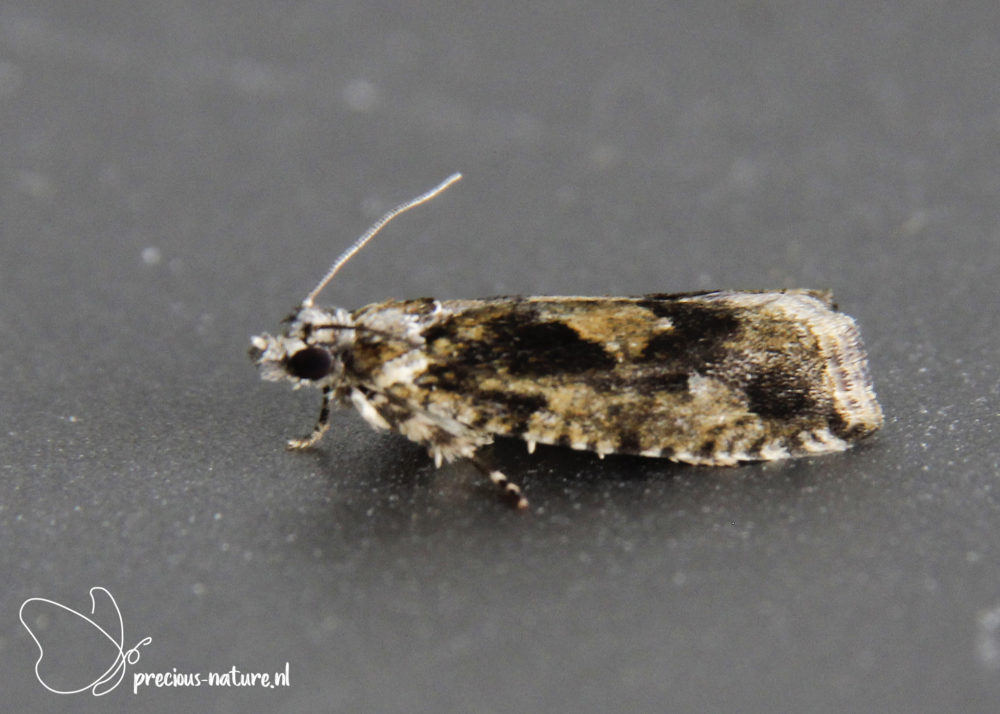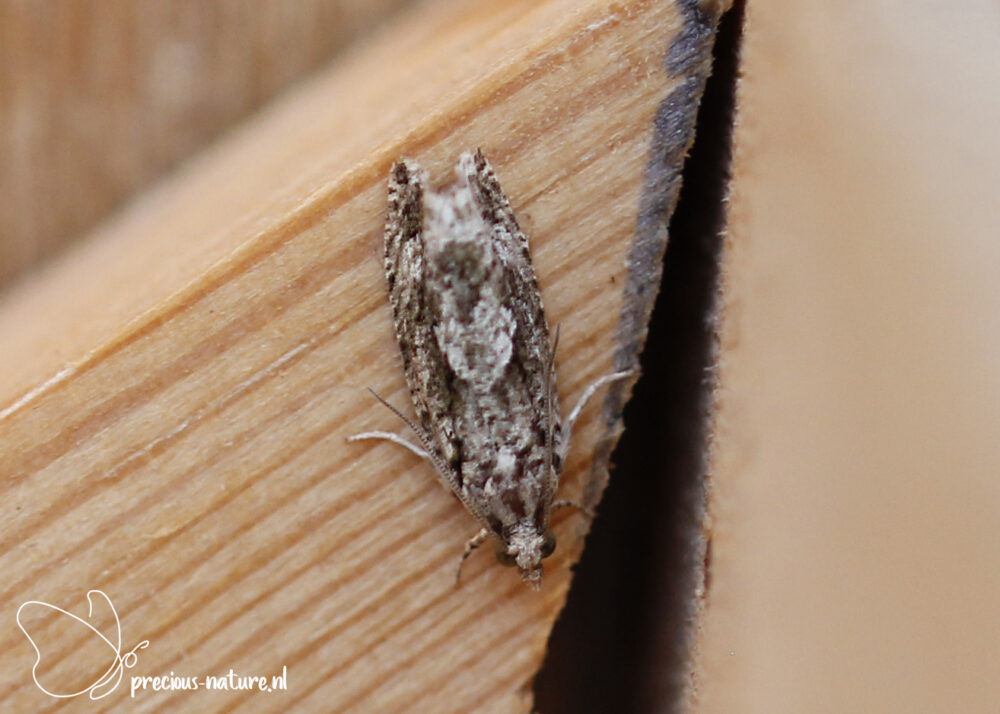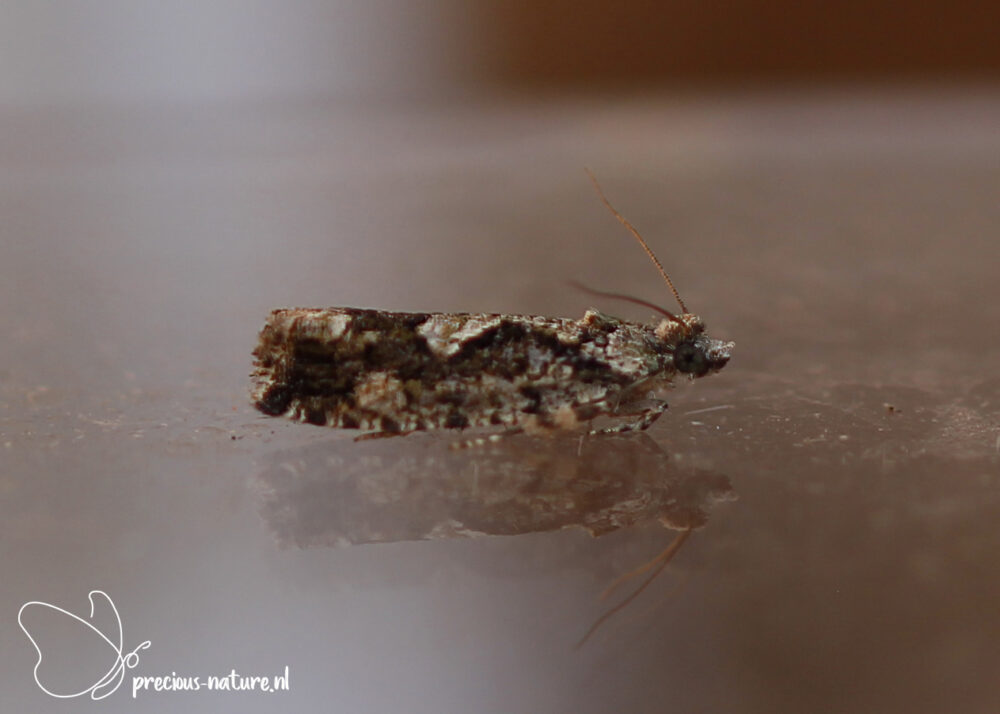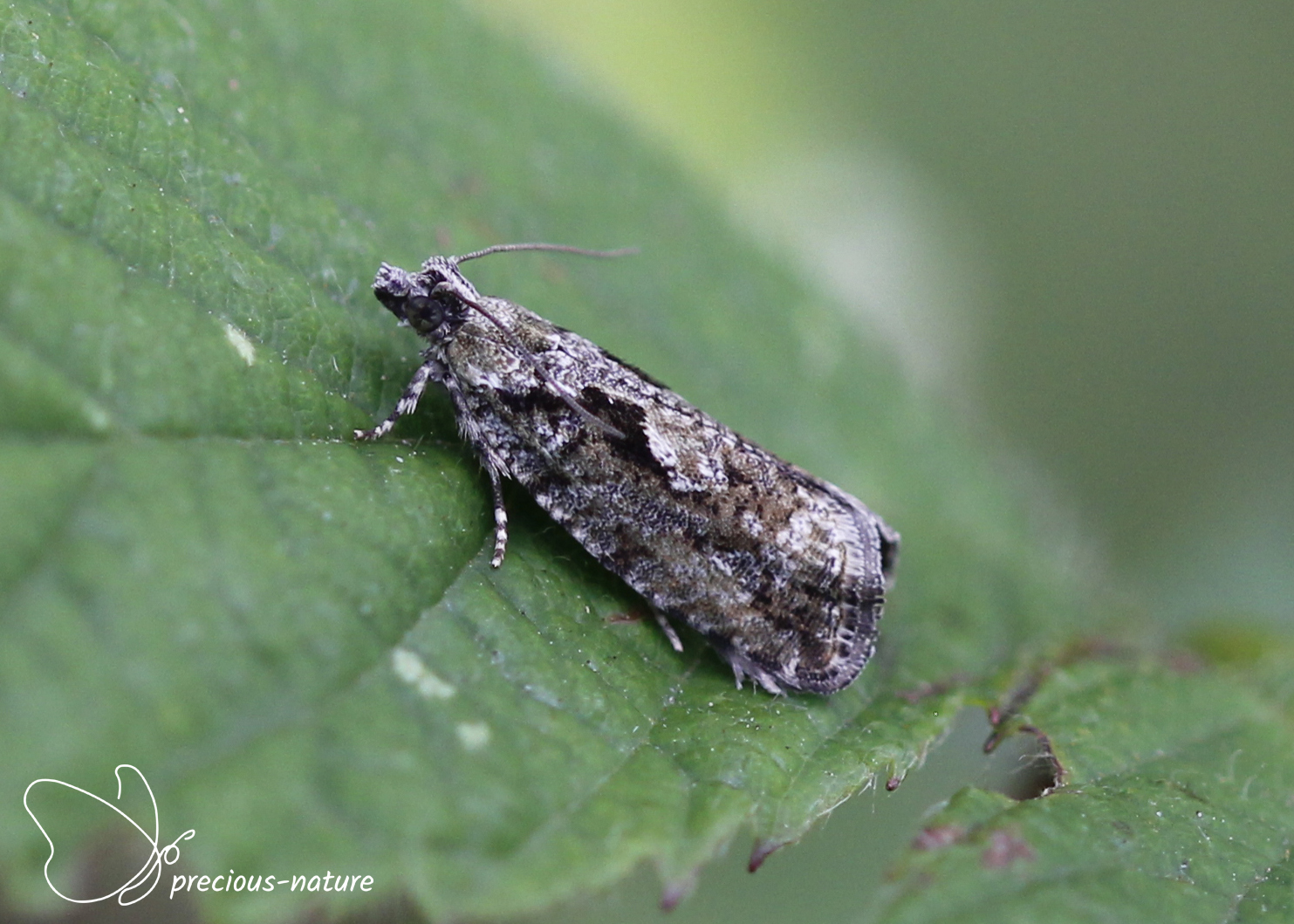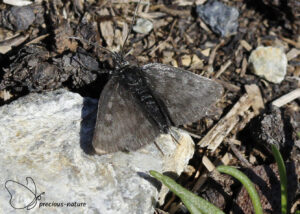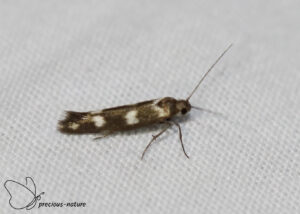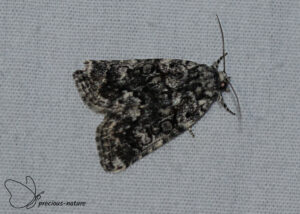
Eucosmini is a tribe within the subfamily Olethreutinae of the family Leafrollers (Tortricidae). It is a large tribe with approximately 1,650 described species consisting of 55 genera. In Europe, the genera Epiblema, Epinotia, Eucosma, Notocelia, and Spilonota, among others, occur. The greatest diversity is found in the colder parts of the Northern Hemisphere, although members of the tribe occur worldwide. The larvae are leafrollers, leaf-spinners, or stem and root borers. A possible characteristic of the tribe is the base of vein a4, which curves towards the base of vein a3 in the hindwing.
Tribe: Eucosmini
Genus: Epiblema
Thistle Bell – 2017 (NL)
(NCBI-index: 1.100980)
The Thistle Bell (Epiblema scutulana) is a moth that is very difficult to distinguish from the Southern Thistle Bell. It is a reasonably dark moth with a noticeable white spot in the centre of the wings. This is best seen when the moth is in a resting position. It looks like a saddle to which it owes its Dutch name. In some specimens, you can see that the white spot is more of a white band. Flight time is from May to June in one generation, and the wingspan is 18-23mm. The larvae live in the stems and roots. Host plant: Musk Thistle, Spear Thistle. Dutch name: Distelzadelmot. Frisian name: –
Flying period:

Tribe: Eucosmini
Genus: Epiblema
White-foot Bell – 2020 (NL)
(NCBI-index: 1.100979)
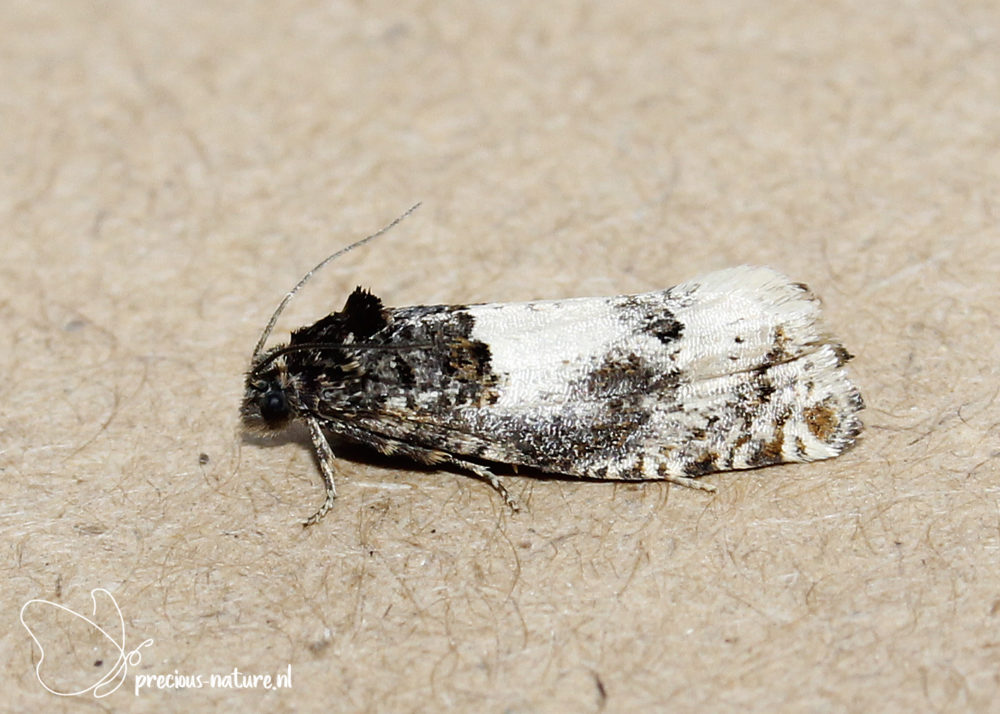
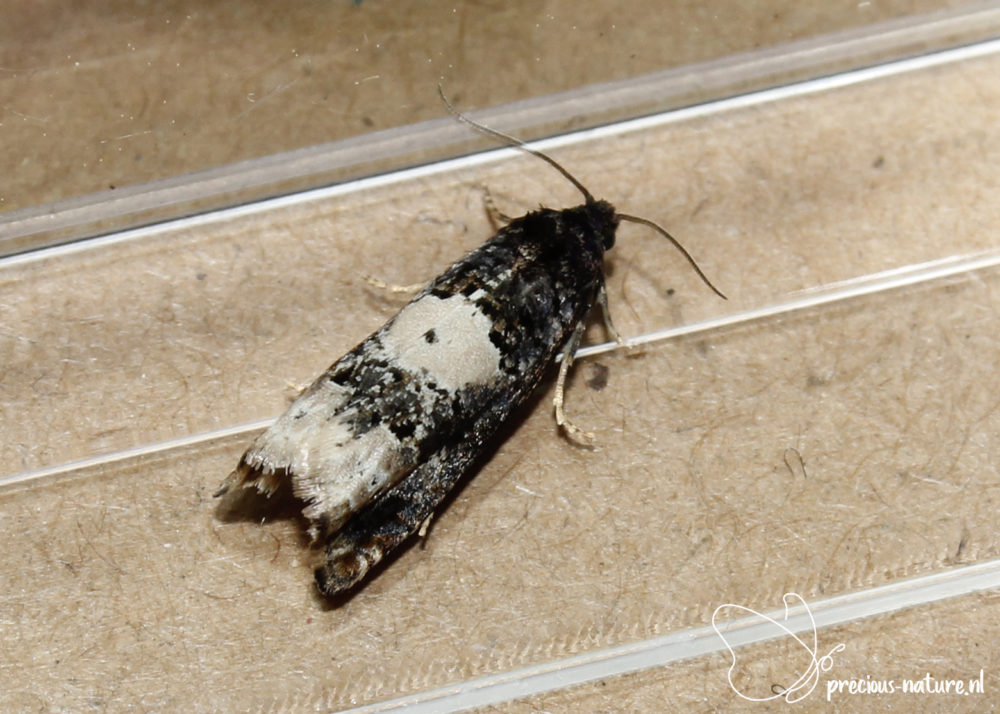
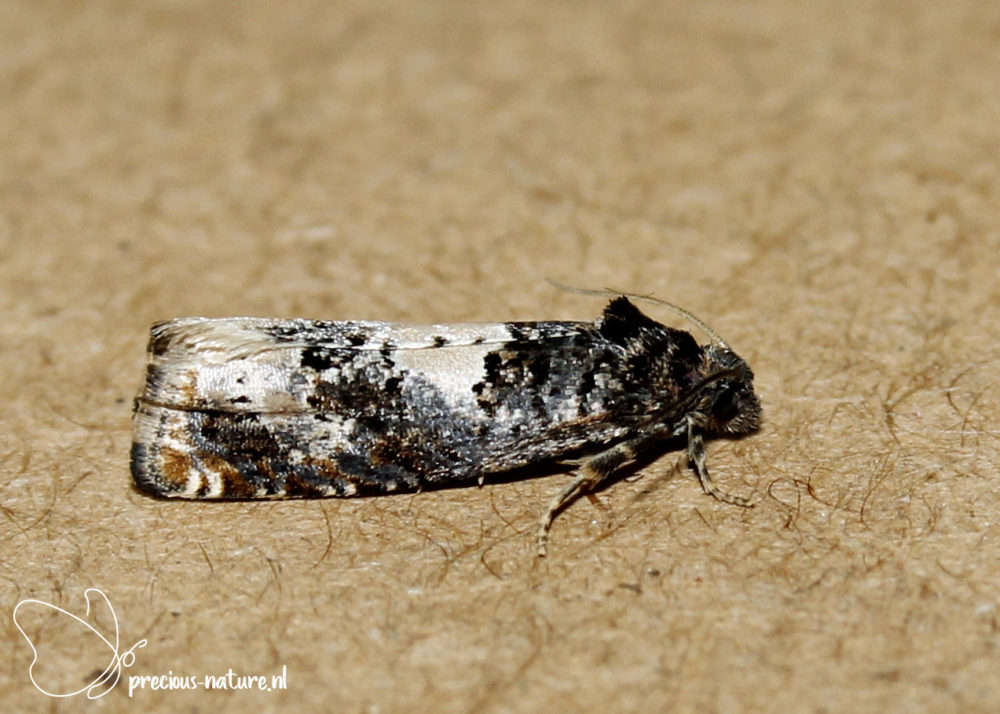
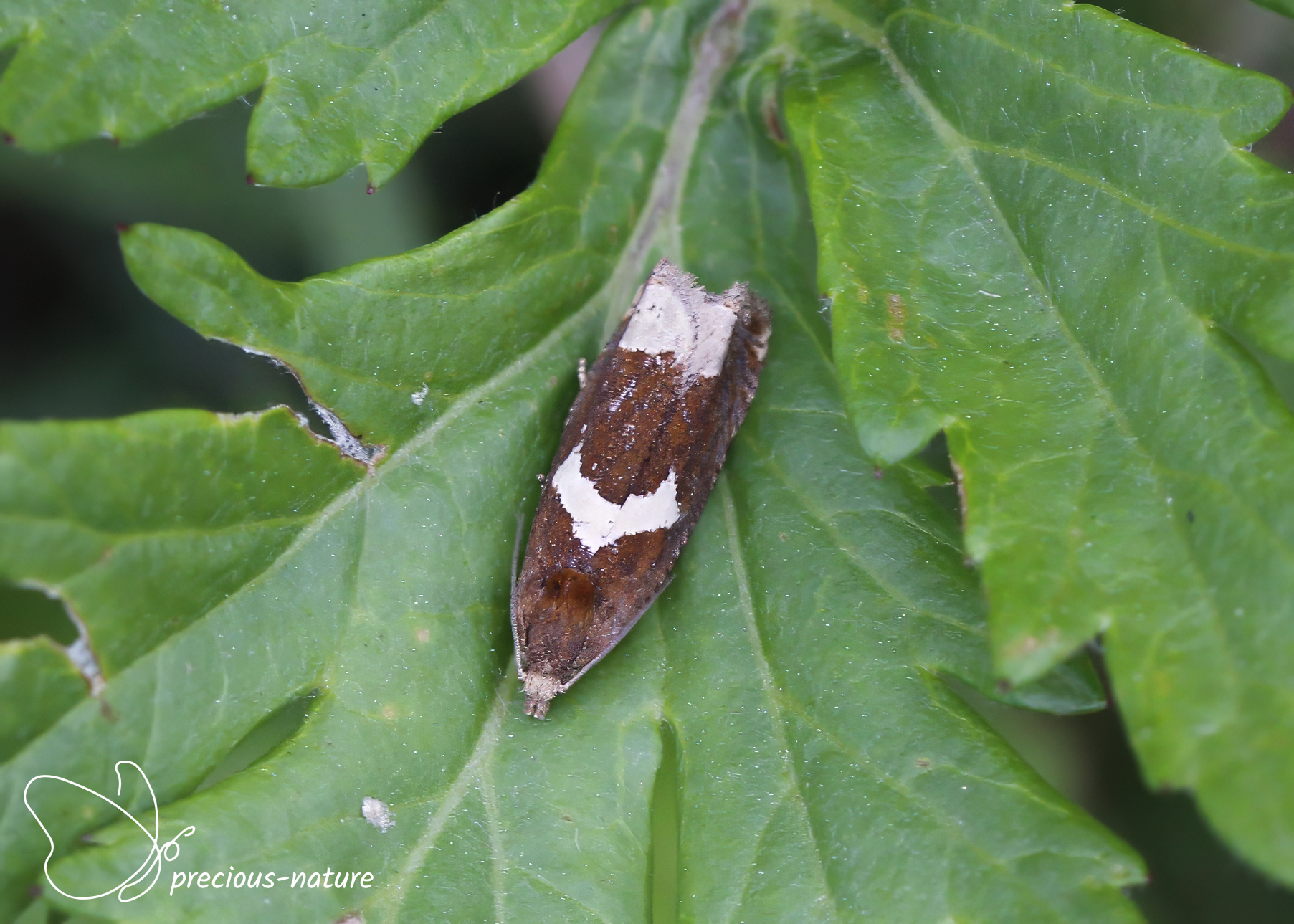
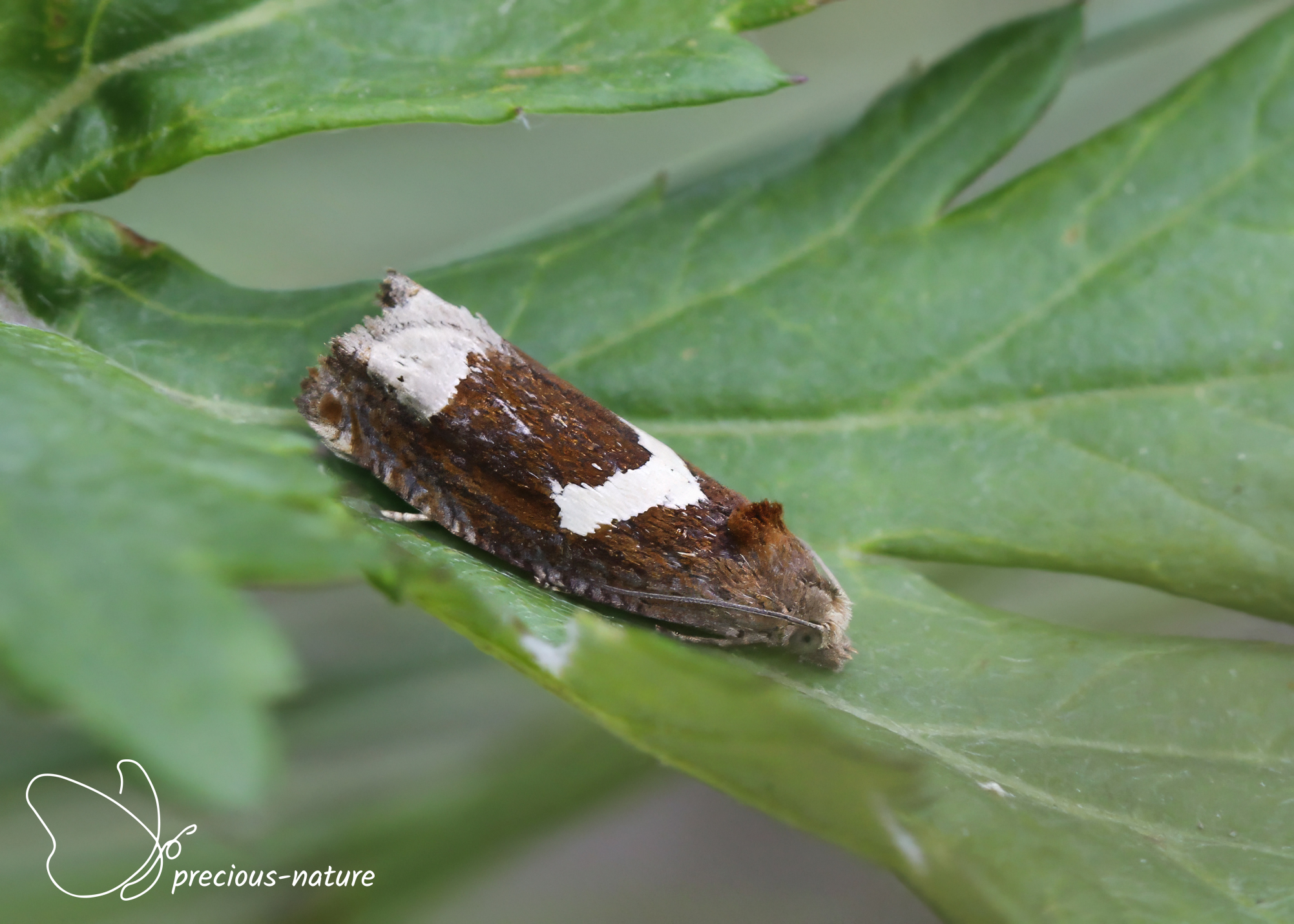
The most striking thing about the White-foot Belle (Epiblema foenella) is the white, sometimes grey, curved spot near the dorsum. Above, it looks like a white horseshoe or bell on the purple-brown forewing to red-brown forewing. Near the tornus is a pale round spot with often three or four black or brown dots. Sometimes, the white marking is also missing. The flying period is from the end of June to September in one generation, and the wingspan is 17-26 mm. Larvae feed on the roots and stems of the host plant. Host plant: Mugwort. Dutch name: Hoefijzermot. Frisian name: –
Flying period:

Tribe: Eucosmini
Genus: Epinotia
Crescent Bell – 2020 (NL)
(NCBI-index: 1.594293)
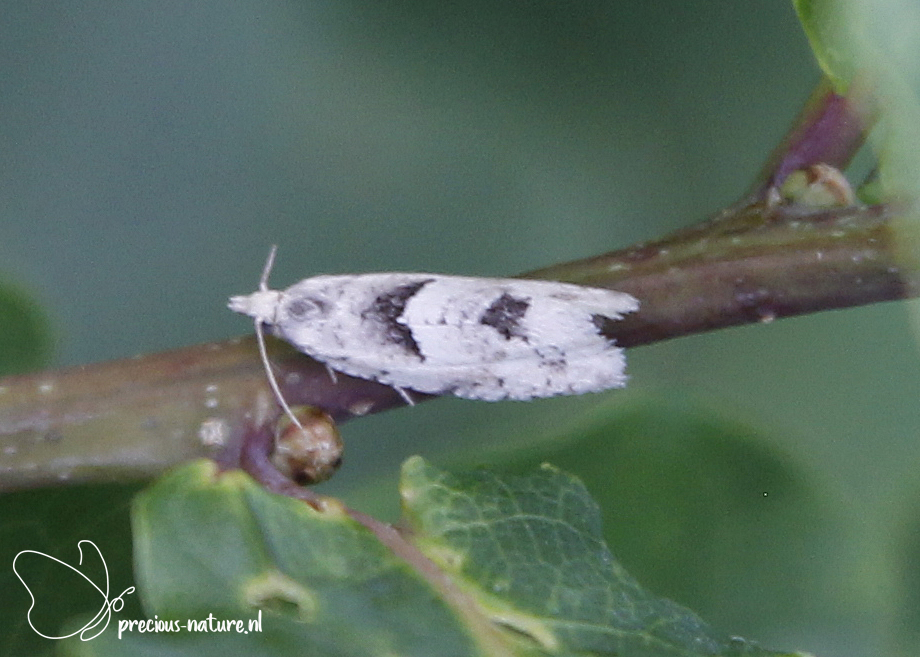
The Crescent Bell (Epinotia bilunana) is almost entirely cream-white or grey-white and otherwise sparsely speckled with black. At the dorsum at 1/3, a black spot could be seen that is dark and sharply drawn at the end. Just before the tornus is another striking black spot. The flying period spans from July to October in one generation, and the wingspan ranges from 13 to 17 mm. The larvae feed on the catkins of a birch tree. Host plant: Birch. Dutch name: Witte oogbladroller. Frisian name: –
Flying period:


Tribe: Eucosmini
Genus: Epinotia
Willow Tortrix – 2020 (NL)
(NCBI-index: 1.666554)
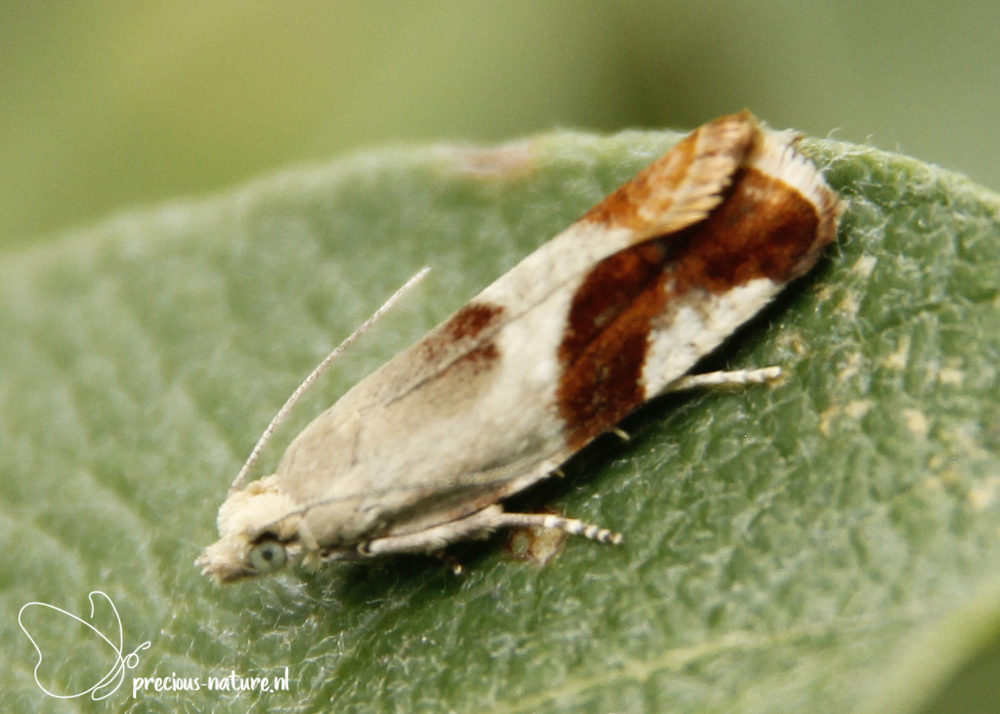
The orange-brown or red-brown colour on the forewings of the beautiful Willow Tortrix (Epinotia cruciana) makes this species easy to recognise. Halfway down the forewing is a light cross band that stands out compared to the light brown base. At the costa, close to the apex, is a white spot that can vary in size. The flying period is from May to early August in one generation, and the wingspan is 12-15 mm. The larvae feed on spun leaves. Host plant: Willow. Dutch name: Fraaie oogbladroller. Frisian name: –
Flying period:

Tribe: Eucosmini
Genus: Epinotia
Brown Elm Bell – 2023 (NL)
(NCBI-index: 1.594292)
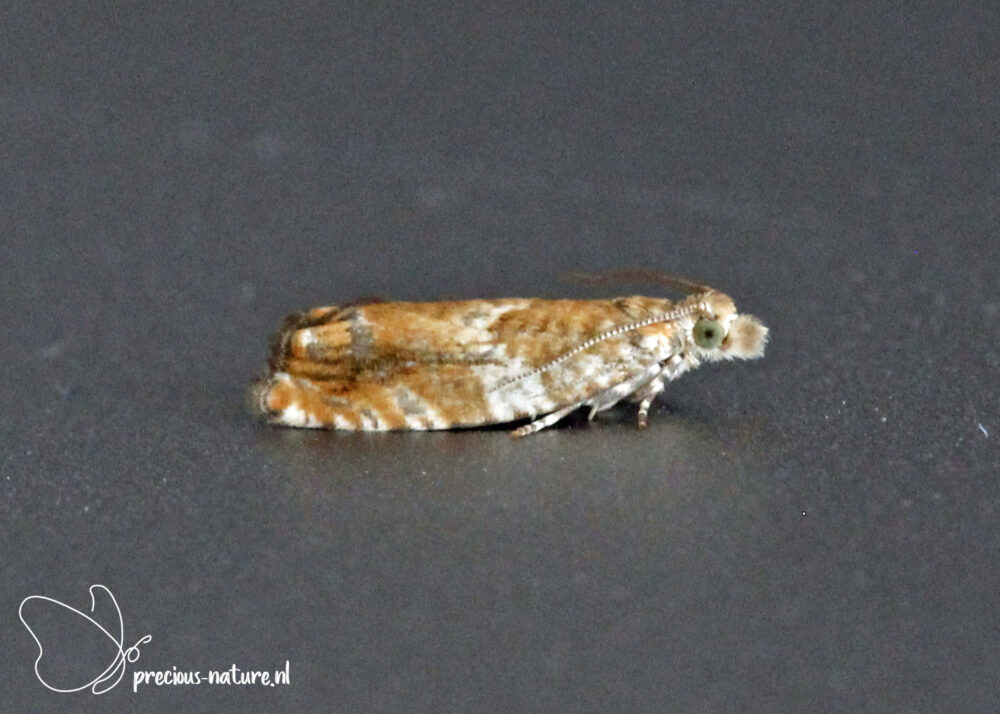
Contrary to what one might initially think based on the Dutch name, it has nothing to do with the colour of the eyes. The “eye” refers to a dark spot on the forewing near the wing tip. This is often brown, black, or dark orange, such as for the Brown Elm Bell (Epinotia abbreviana). The Brown Elm Bell is variable in colour and markings. The forewing is orange-brown to dark red-brown with a creamy white or yellow-brown transverse band on a 1/3, making an acute angle inward halfway. Another narrow white band runs towards the leading edge from the inner edge corner, covered with silver-coloured scales. At the leading edge, you can also see several paired white bands that are particularly noticeable near the wing tip. The flight period spans one generation, from May to August, and the wingspan ranges from 12 to 16 mm. Host plant: Elm. Dutch name: Oranje oogbladroller. Frisian name: –
Flying period:
Tribe: Eucosmini
Genus: Epinotia
Nut Bud Moth – 2025 (NL)
(NCBI-index: 1.660628)
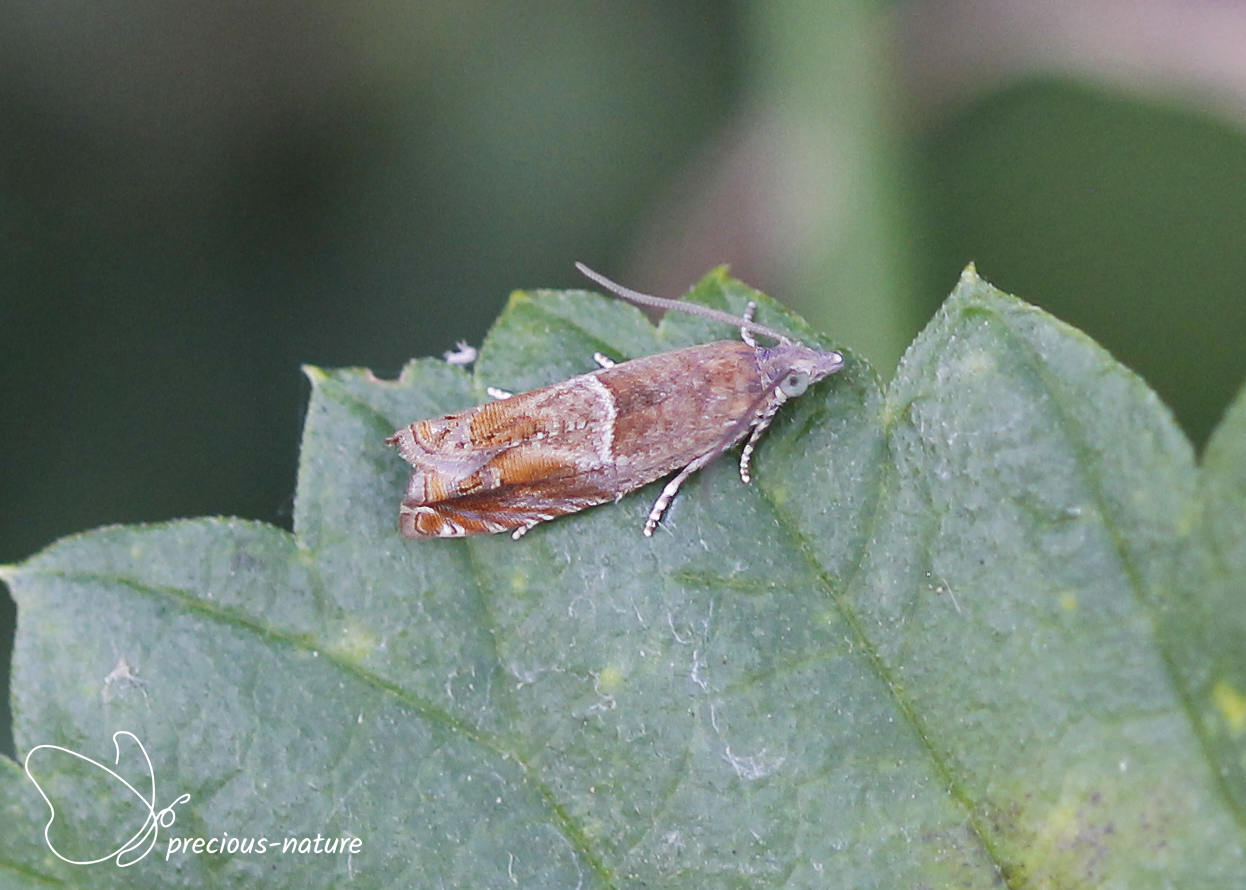
In areas where hazel and alder grow, you can also encounter the Nut Bud Moth (Epinotia tenerana). It is a pretty common species in the Netherlands. The forewing is orange-brown or dark brown, suffused with yellow-brown, with a whitish square spot with fine brownish lines on the back at about half the height. The inner edge of the white spot is sharply defined and almost perpendicular to the back. The spot is sometimes diagonally connected to a whitish spot at the front edge to form a transverse band, which is constricted in the middle. The ocellus is weak and contains three or four black stripes; these are often reduced or absent. One form is unclearly marked, with the whitish colour replaced by light orange-brown. The flight period is one generation from mid-June to late September, and the wingspan is 12-16 mm. Host plant: Hazel, Alder. Dutch name: V-oogbladroller. Frisian name: –
Flying period:

Tribe: Eucosmini
Genus: Eucosma
Hoary Bell – 2020 (NL)
(NCBI-index: 1.100988)
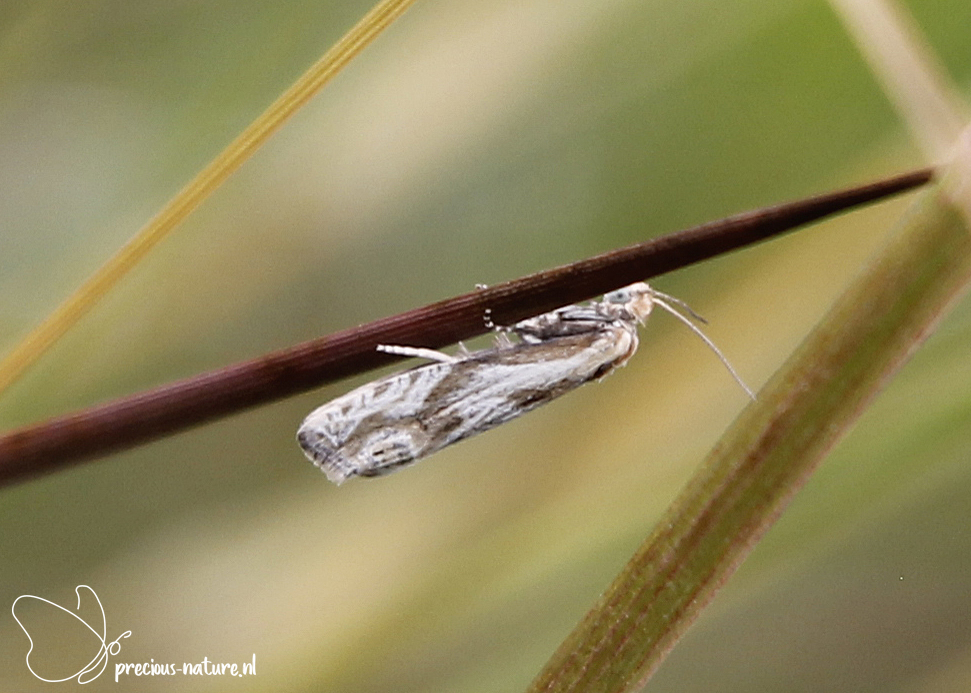
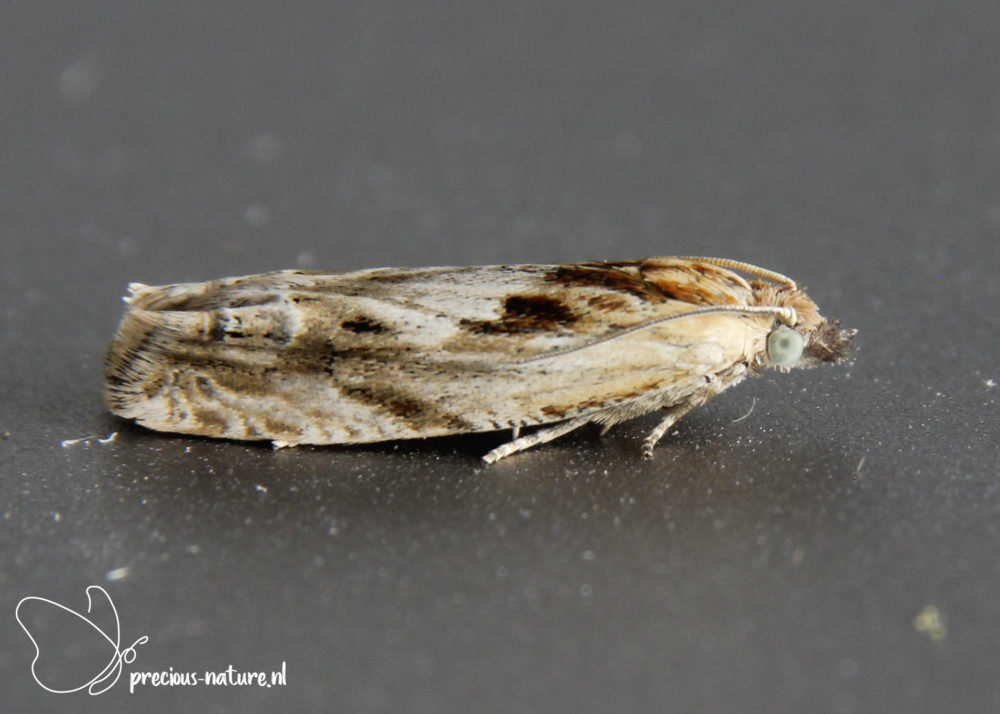
The Hoary Bell (Eucosma cana) has a grey-brown to dark brown forewing with white-brown or yellow-brown spots. Along the costa, a brown streak can be seen from the base to the middle of the wing. Three small brown spots can be seen towards the apex. From the costa, a brown median band runs halfway across the wing towards the dorsum. The flying period spans from May to August in one generation, and the wingspan ranges from 16 to 23 mm. The larvae feed on the flower buds and seeds of the host plant. Host plant: Thistle, Common Knapweed. Dutch name: Distelknoopvlekje. Frisian name: –
Flying period:
Tribe: Eucosmini
Genus: Gypsonoma
Common Cloaked Shoot – 2019 (NL)
(NCBI-index: 1.594308)
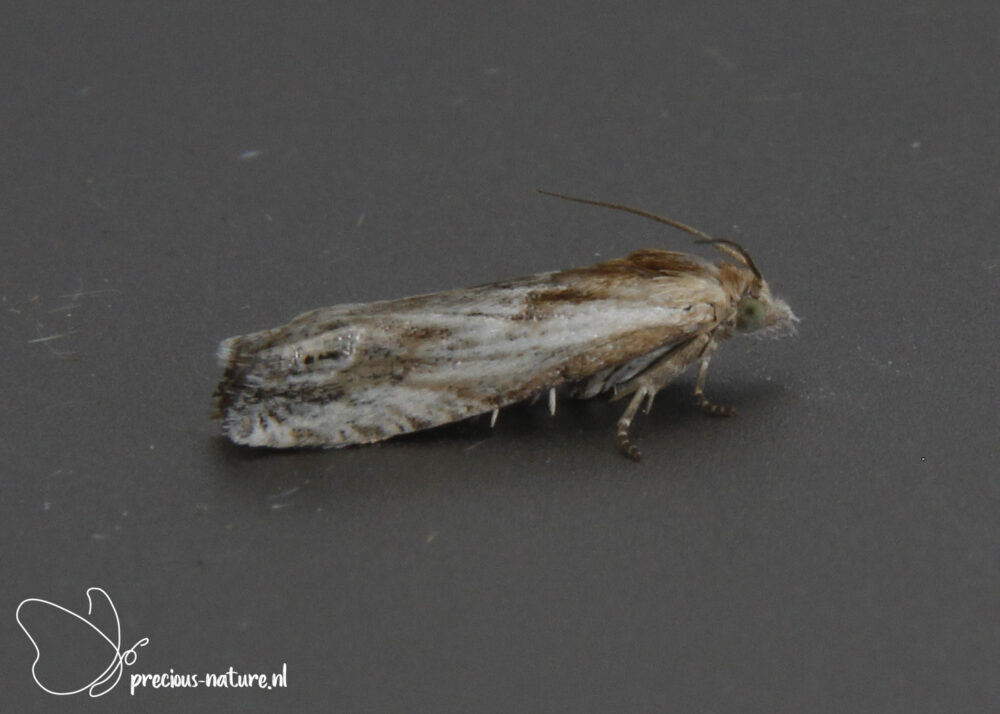
A leafroller variable in colour is the Common Cloaked Shoot (Gypsonoma dealbana) that just perched on the leaves of the butterfly bush on a summer evening. The head of this leafroller is brown, sometimes mixed with some grey-white. The forewing is white with a dark grey base and black spots. At 2/3, a clear black line is in the middle of the wing. There are orange-brown spots at the apex. The flying period spans from May to August in one generation, and the wingspan ranges from 11 to 14 mm. The larvae feed on a range of deciduous trees, feeding on leaves in autumn and eating the buds, catkins, young shoots, and then spinning leaves in the spring. Host plant: Hawthorn, Oak, Poplar, Sallow, Hazel. Dutch name: Loofboombladroller. Frisian name: –
Flying period:
Tribe: Eucosmini
Genus: Notocelia
Yellow-faced Bell – 2018 (NL)
(NCBI-index: 1.101023)
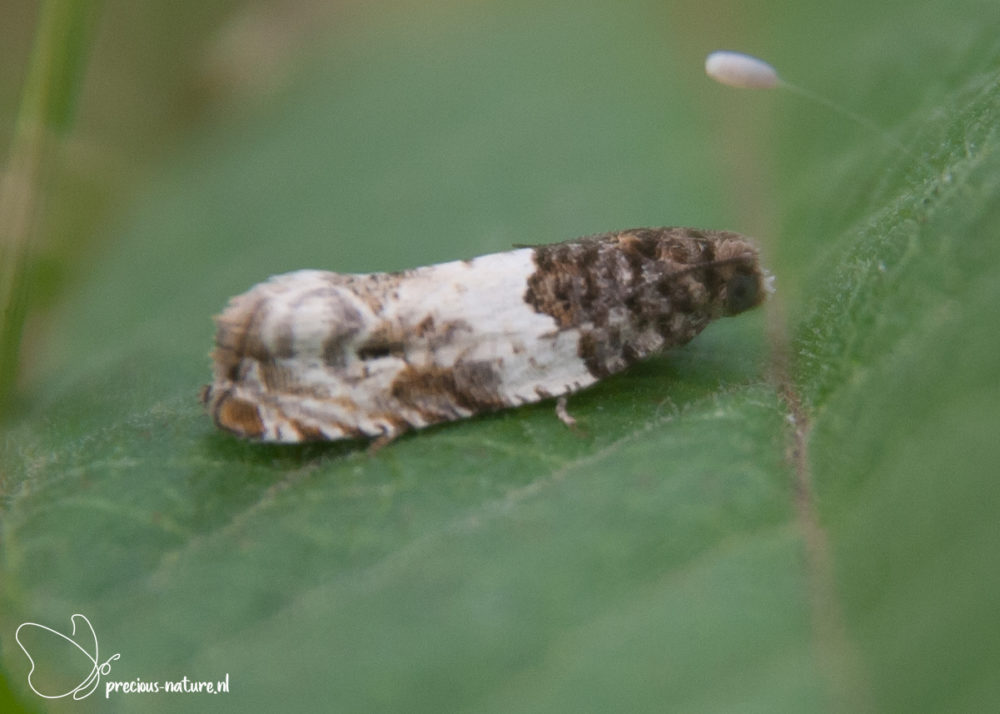
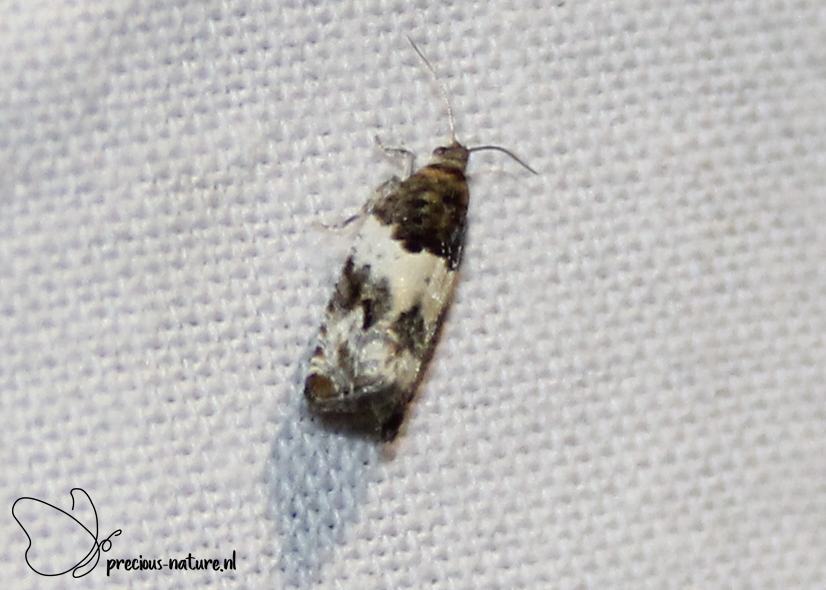
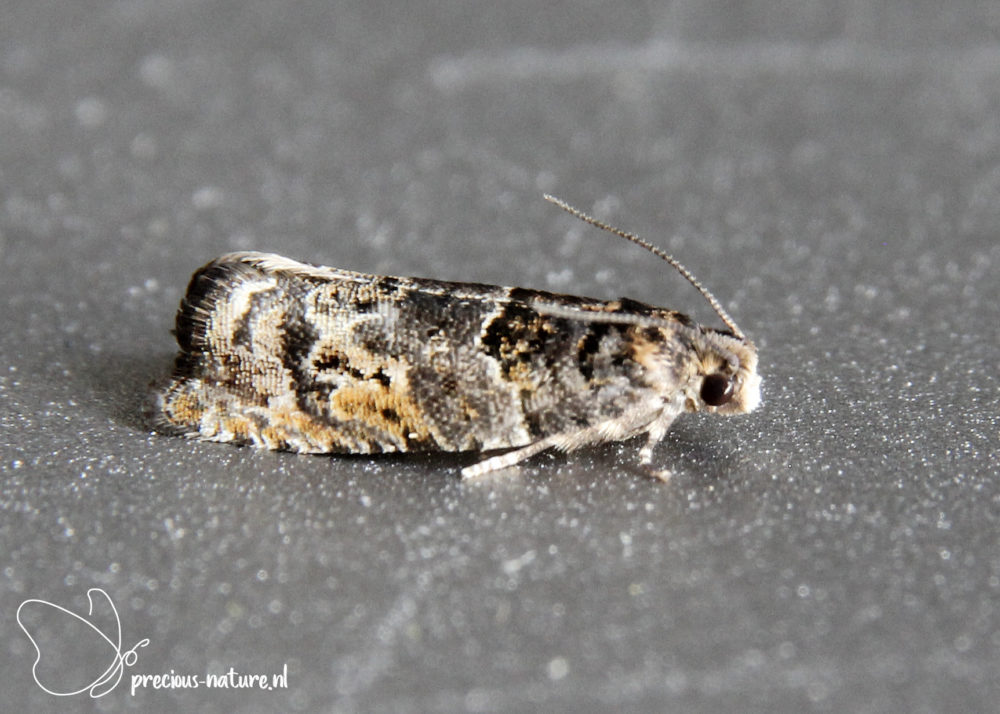
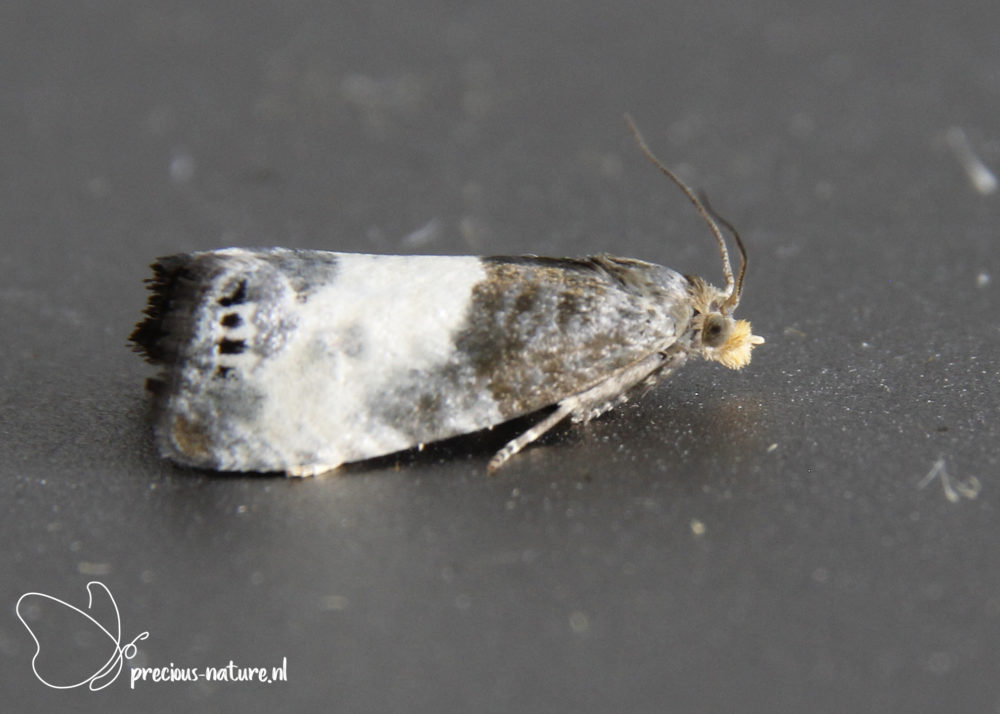
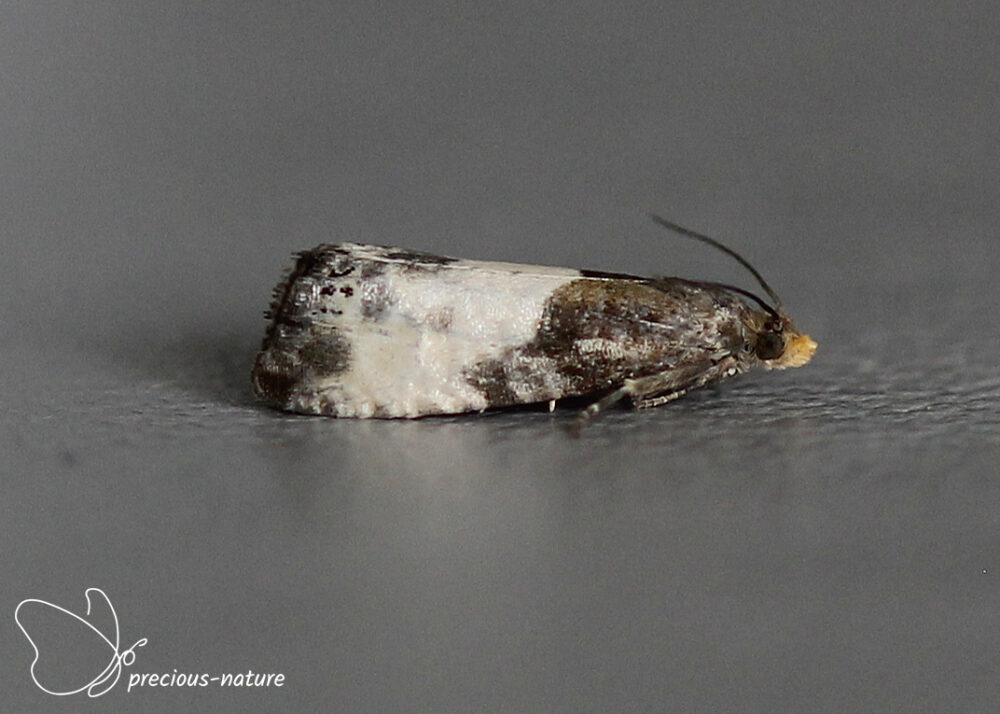
The most striking thing about the Yellow-faced Bell (Notocelia cynosbatella) is the palps, which have a yellow-to-orange colour. One-third of the forewing is black to brownish, and the rest is creamy white with occasional light grey or brown blotches. At the end of the wings is a narrow strip that is grey-brown. The flying period in one generation is from May to July, and the wingspan is 16-22 mm. Larvae feed on flower buds, young shoots, or between leaves. Host plant: Roses, Bramble. Dutch name: Hermelijnbladroller. Frisian name: –
Flying period:

Tribe: Eucosmini
Genus: Notocelia
Bramble Shoot Moth – 2020 (NL)
(NCBI-index: 1.594315)
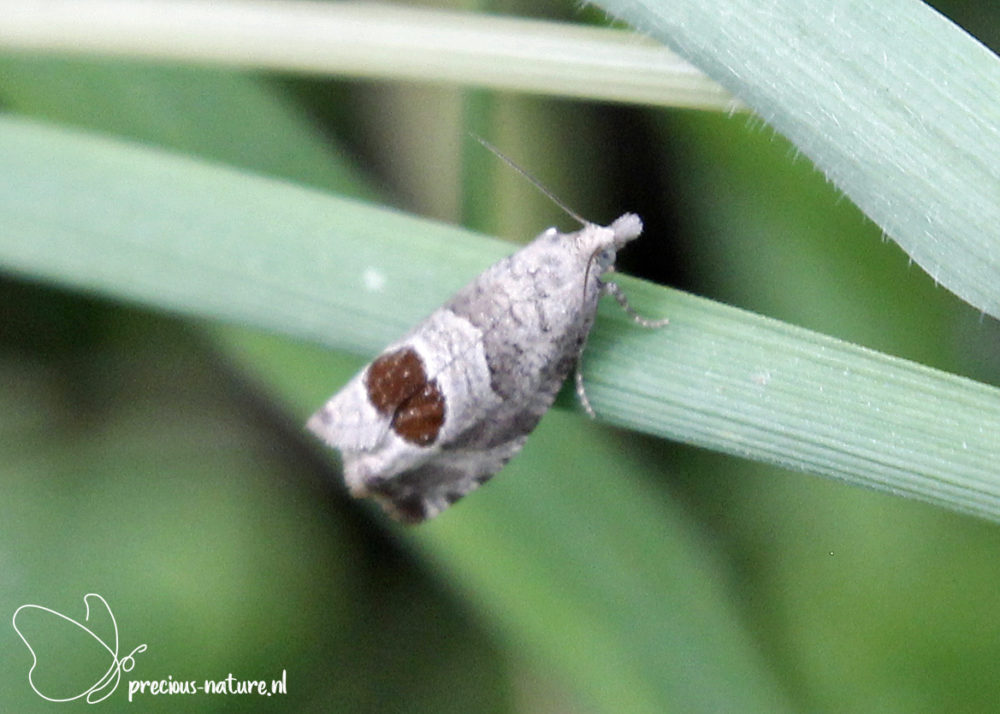
The Bramble Shoot Moth (Notocelia uddmanniana) is easily recognised by the dark brown arc-shaped spot on the dorsum of the otherwise grey forewing. This dark brown spot is outlined in white. At 1/3 is a dark grey band that extends towards the costa. A dark grey band can be seen along the costa, which slowly deflects to the brown spot. A light brown zone can be seen along the termen. The flying period is from mid-May to October, and the wingspan is 15-20 mm. The larvae feed on an untidy spinning. Host plant: Blackberry, Raspberry. Dutch name: Bramenbladroller. Frisian name: –
Flying period:

Tribe: Eucosmini
Genus: Notocelia
Common Rose Bell – 2021 (NL)
(NCBI-index: 1.594313)
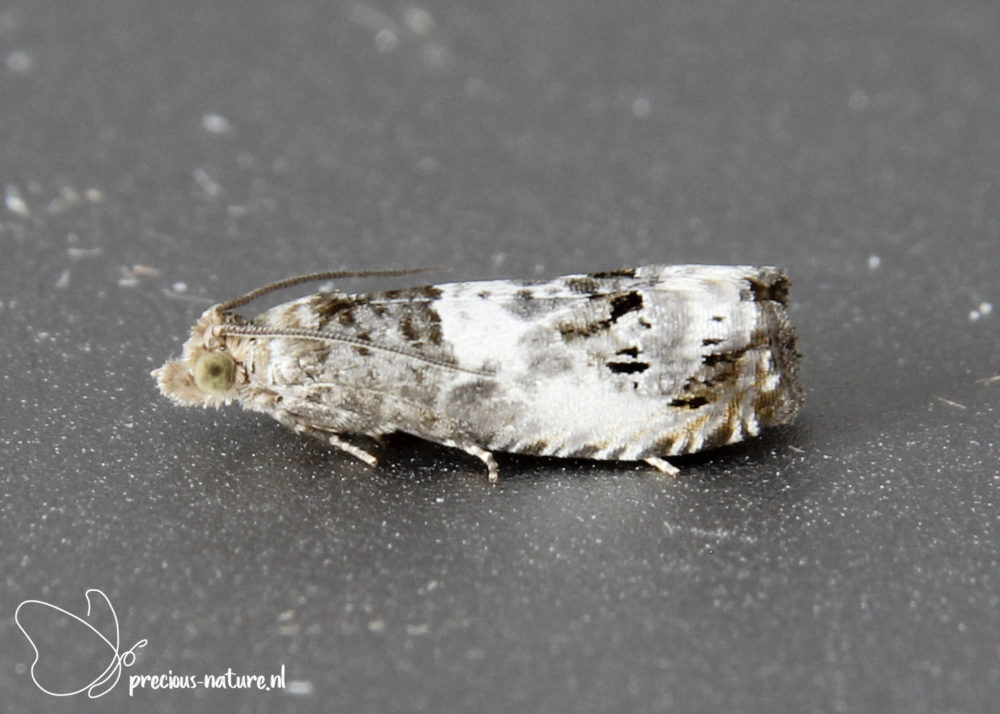
The forewing of the Common Rose Bell (Notocelia roseacolana) is white and partly spotted with lead grey, especially the wing base. Along the leading edge from the wingtip to halfway, you see dark grey triangular spots with narrow grey, sometimes light brown, narrow lines in between. In the marginal area is a row of tiny black dots. A brown spot is faintly visible in the grey spot near the trailing edge, and a black spot is on the edge of this grey spot. The Common Rose Bell is similar to the Triple-blotched Bell (Notocelia trimaculana), but is usually larger and has a broader forewing. In addition, the forewing is often paler in colour, and the spots at the leading edge are finer and more oblique. The wingspan is 15-20 mm, and the flight period spans one generation, from late May to August. Host plant: Hawthorn. Dutch name: Rozenhermelijnbladroller. Frisian name: –
Flying period:
Tribe: Eucosmini
Genus: Notocelia
Summer Rose Bell – 2021 (NL)
(NCBI-index: 1.101024)
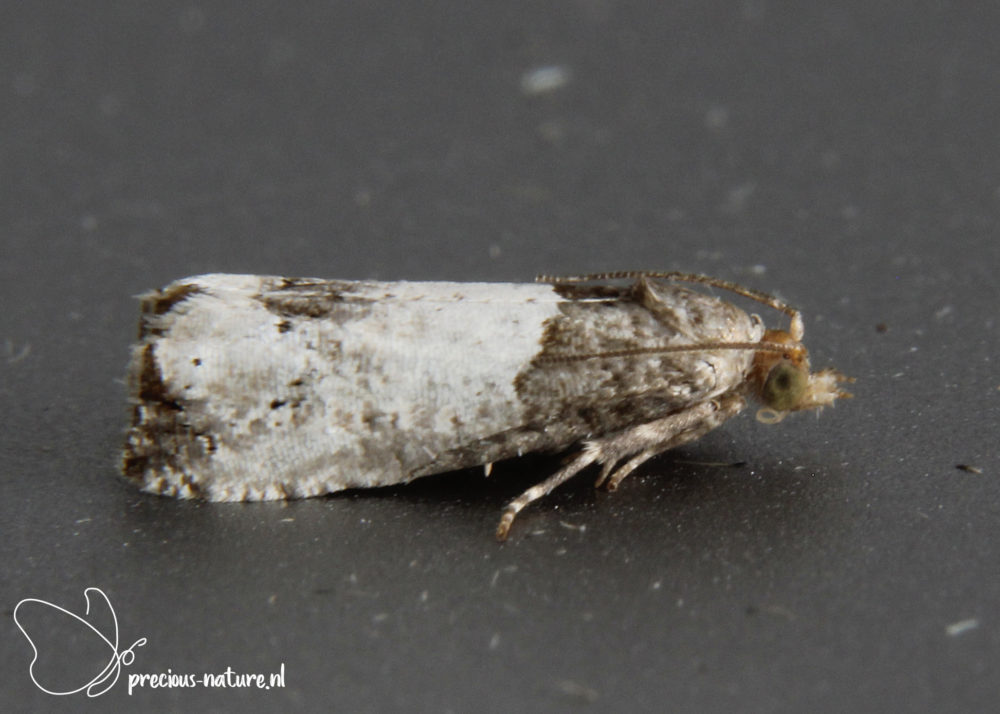
The Summer Rose Bell (Notocelia roborana) is very similar to the Common Rose Bell (Notocelia roseacolana), but is larger and has fewer grey spots and black markings in the forewing. The base of the forewing is grey, with the grey surface sloping slightly away and then bending with an arc to the leading edge. With the Common Rose Bell, it is more linear. Along the trailing edge near the tornus is a dark grey spot with a black spot. The wingspan is 18-21 mm, and the flight period runs in one generation from mid-June to August. Host plant: Roses. Dutch name: Scherpe hermelijnbladroller. Frisian name: –
Flying period:

Tribe: Eucosmini
Genus: Notocelia
Square-spot Bell – 2024 (CH)
(NCBI-index: 1.594314)
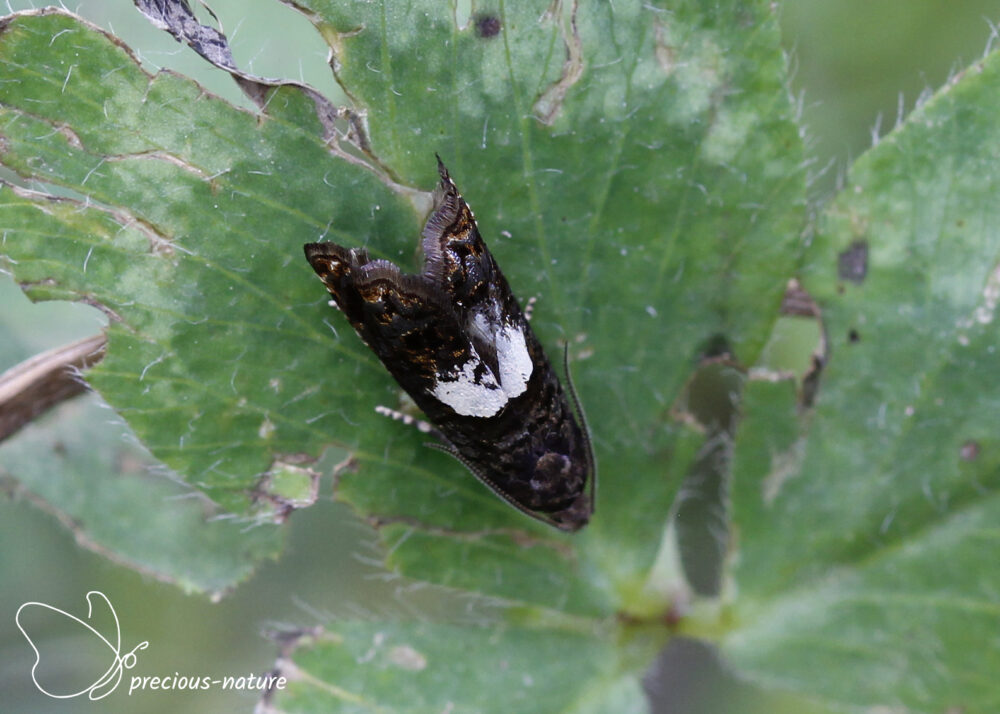
The forewing of the Square-spot Bell (Notocelia tetragonana) is relatively broad and is black-brown with blue-grey metallic reflections and a scattering of yellow-brown scales. This is mainly visible in the outer half of the wing. A striking, angular white spot can be seen halfway along the inner edge of the wing. The flight period is one generation from June to July, and the wingspan is 13-16 mm. Host plant: Wild Rose, Bramble. Dutch name: Vierkantvlekbladroller. Frisian name: –
Flying period:

Tribe: Eucosmini
Genus: Rhopobota
Holly Tortrix – 2017 (NL)
(NCBI-index: 572892)
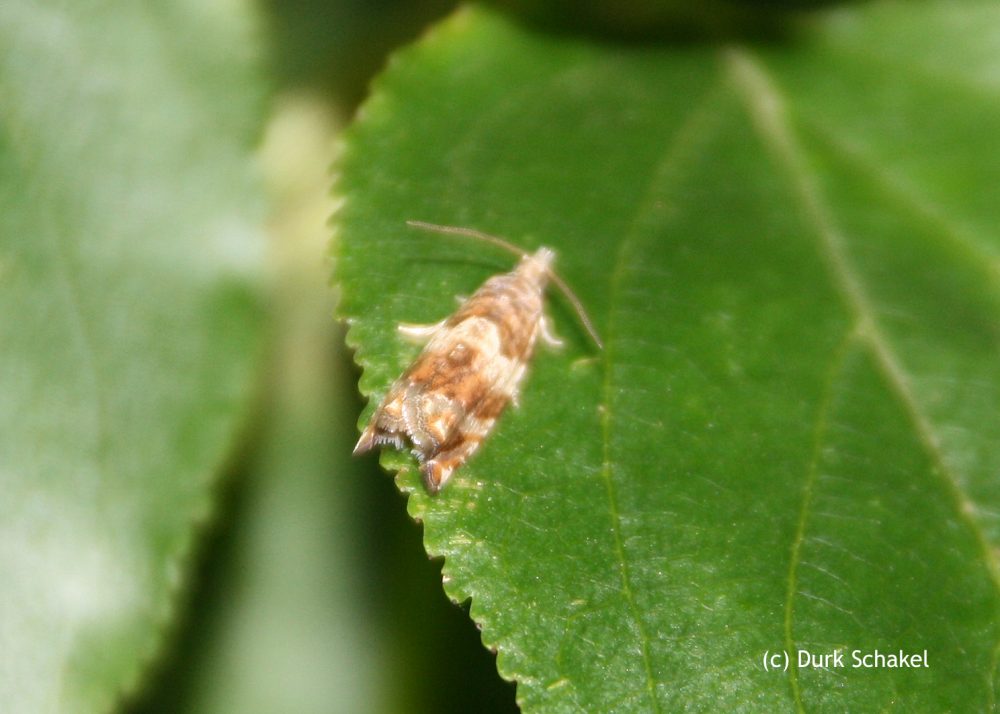
The Holly Tortrix (Rhopobota nirvana) has a light grey or light brown ground colour with two wider cross bands on the top that are darker. Flight time is from July to September in one generation, and the wingspan is 12-16 mm. Host plant: Blackthorn, Hawthorn, Holly, Bilberry. Dutch name: Topspinnertje. Frisian name: –
Flying period:
Tribe: Eucosmini
Genus: Rhyacionia
Pine Shoot Moth – 2019 (NL)
(NCBI-index: 1.101046)
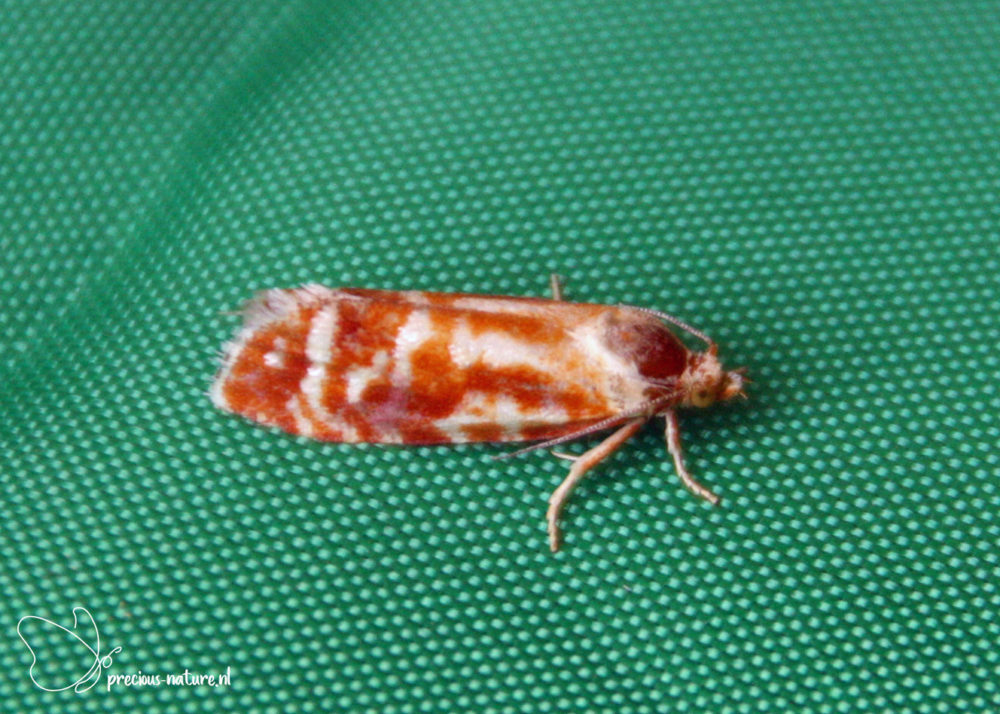
The Pine Shoot Moth (Rhyacionia buoliana) has an easily identifiable and striking appearance. This leafroller is very similar to the Orange-spotted Shoot (Rhyacionia pinicolana). Still, when you look closely at the irregular white line pattern, the Pine Shoot Moth shows an arc-shaped drawing at the end of the costa that does not continue to the centre. With the Orange-spotted Shoot, that white line continues to the apex. The forewing is otherwise bright orange, sometimes drenched with yellow-brown or reddish-brown. The flying period spans from June to August in one generation, and the wingspan ranges from 16 to 24 mm. Larvae bore into the shoots. Host plant: Scots Pine. Dutch name: Gewone dennenlotboorder. Frisian name: –
Flying period:
Tribe: Eucosmini
Genus: Spilonota
Bud Moth – 2018 (NL)
(NCBI-index: 572898)
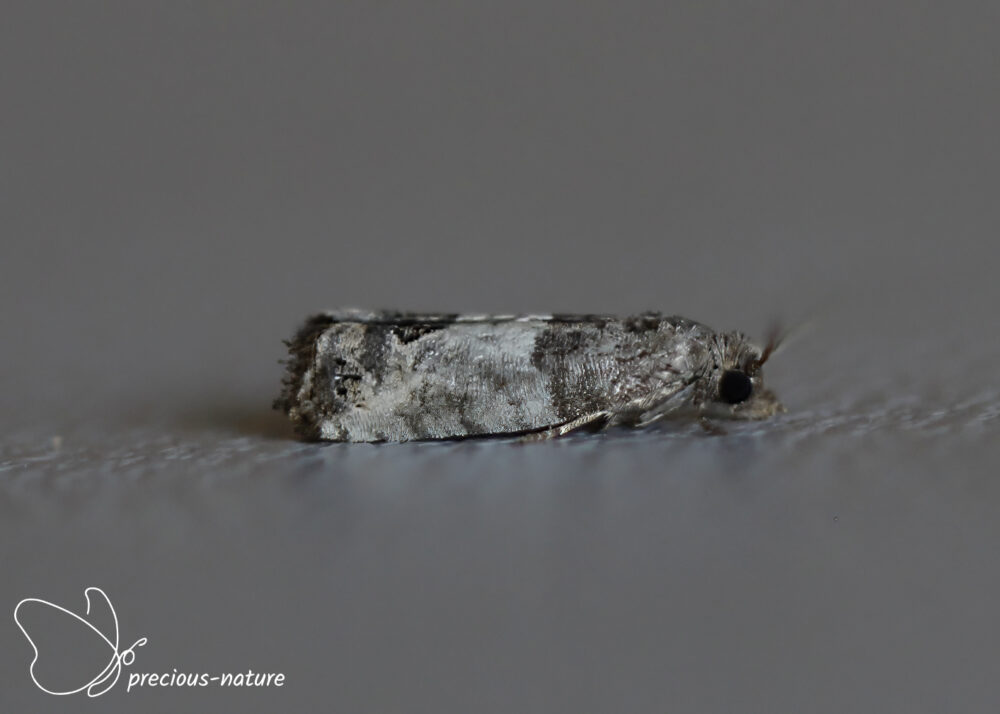
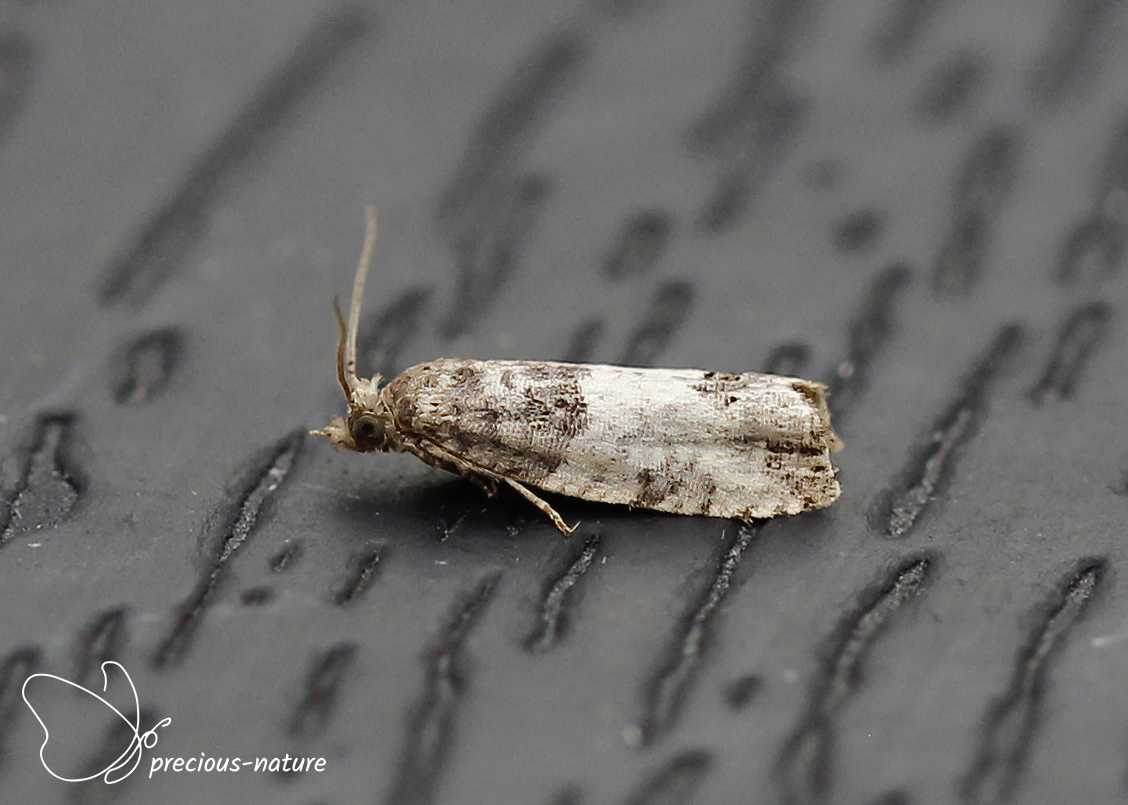
The Bud Moth (Spilonota ocellana) is a leafroller that is difficult to distinguish from the Larch-bud Moth (Spilonota laricana). A genitalia examination is needed, but it can be recognised because the Bud Moth has narrower forewings, is greyer, and has more black spots. The forewing of the Bud Moth is white, sometimes a pale yellow-brown with a grey diffuse colour. From the base, the forewings are black-brown up to a third and white for the rest. Usually, there is a black triangular mark near the apex. Lead grey spots can be seen from the apex to the dorsum. When resting, you can see a dark mark from above after those grey markings. The flying period in one generation is from May to September, and the wingspan is 12-17 mm. The larvae feed on a wide range of shrubs and trees and, as the English name suggests, burrow into the buds during the spring, causing them to wither. Host plant: Oak, Apple, Hawthorn, Sallow. Dutch name: Rode knopbladroller. Frisian name: –
Flying period:

Tribe: Eucosmini
Genus: Zeiraphera
Cock’s-head Bell – 2021 (NL)
(NCBI-index: 1.101070)
The Cock’s-head Bell (Zeiraphera isertana) is very similar to the Larch Tortrix (Zeiraphera griseana). The difference is in the light blotch halfway down the wing on the dorsum that extends towards the costa. With the Cock’s-head Bell, that spot never extends past the centre, whereas the spot on the Larch Tortrix goes past it. In addition, the Cock’s-head Bell is somewhat smaller and has shorter wings. The forewing is otherwise black or black-brown with white or grey markings. The flight period is one generation from May to September, and the wingspan is about 17 mm. Host plant: Oak. Dutch name: Grootkopbladroller. Frisian name: –
Flying period: